

There's a strange kind of pressure that comes with being a yoga teacher today. You finish a class, maybe it went well or didn't, and then you open Instagram and see someone else's highlight reel with perfect lighting, flawless transitions, and hundreds of comments saying, "so inspiring." And somewhere in the back of your mind, an unsettling question forms, “Am I doing this right?”
It's easy to get lost in that comparison. To start measuring your worth by follower counts or how full your classes are, rather than whether your students are really changing.
Yoga was never supposed to work that way.
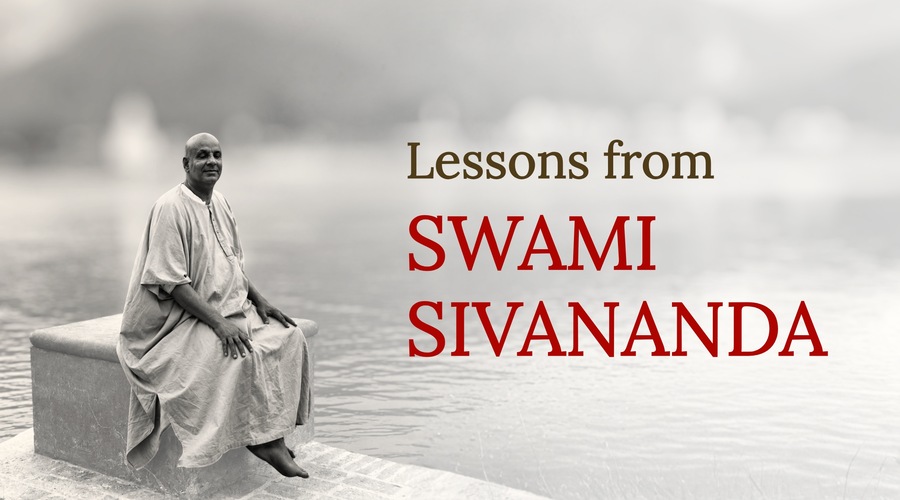
One of the most grounding reminders I always have at the back of my mind is the life of Swami Sivananda. The more you learn from his teachings, the harder it becomes to ignore how much they still apply. He was a man who gave away medicine to the poor, served people with leprosy in the streets of Rishikesh, and wrote over 300 books on yoga and Vedanta because he genuinely couldn't imagine doing anything else. His story feels like a steady hand on the shoulder when you've forgotten what you're actually here for. This piece will help you uncover some of his deepest teachings and how you can apply them in your daily practice.
Who Was Swami Sivananda?
Born in 1887 in Tamil Nadu, India, Swami Sivananda trained as a medical doctor, which is, honestly, one of the things that makes his path so fascinating. He had a legitimate career. He knew how bodies worked. He could have built a comfortable life.
But he encountered a major transformative phase in his life.
Working as a doctor in Malaysia, he treated patients day after day and kept noticing the same thing that physical healing alone wasn't enough. People got better physically and still carried something heavy inside such as grief, disconnection, and a kind of rootlessness that medicine couldn't touch. That realization occupied his mind to think about it.
From Medicine to Deeper Purpose
In 1923, he left his medical practice, traveled to Rishikesh, and took the vows of a sannyasi, a renunciate. He didn't abandon his medical knowledge. He expanded it into a larger holistic understanding of the human being that addressed suffering at every layer, not just the physical one.
He founded the Divine Life Society in Rishikesh in 1936, trained thousands of students, and built a global Yoga movement, all while maintaining a lifestyle of radical simplicity. The Government of India honored him with the Padma Shri award in 2022, decades after his passing in 1963, a recognition that speaks to how deeply his legacy has endured. In yoga, Swami Sivananda is recognized far beyond Rishikesh, reaching students across the globe for both his philosophy and practice.
Why His Teachings Are Important for Modern Yoga Teachers
Modern Yoga has a real tension running through it.
On one side, you have the classical tradition based on discipline, inner transformation, and the idea that Yoga is fundamentally a way of living. On the other hand, you have the booming wellness industry, where Yoga is often sold as a fitness product, a stress-relief tool, or an aesthetic lifestyle. Neither of those things is wrong, exactly. But when teachers build their entire identity around the second version, the true essence gets quietly hollowed out.
Burnout, self-doubt, and a nagging sense that you're performing rather than teaching. These are remarkably common among Yoga teachers today. Sivananda's teachings don't just address these things philosophically. They offer a more practical set of grounding principles that cut through the noise and bring you back to what yoga really asks of you.
Core Teachings of Swami Sivananda
Sivananda distilled his entire philosophy into six words: Serve, Love, Give, Purify, Meditate, and Realize.
It sounds almost too simple. But when you focus on each word, you start to feel the importance and real meaning of it.
- Serve points toward Karma Yoga, selfless action done without grasping for a result. For a Yoga teacher, that means being fully present for a student who'll never leave you a glowing review, just as much as for the one who will.
- Love is about compassion that reaches beyond ego; the steady, simple kind that stays present even when a student is struggling, resistant, or just difficult to handle.
- Give speaks to generosity without expectation, sharing knowledge freely, not hoarding it as a competitive advantage.
- Purity is the inner work tending to your habits, thoughts, and the way you speak to yourself when you are alone. It's arguably the most important thing on the list.
- Meditate and Realize close the loop. It conveys developing mental clarity and, through consistent practice, arriving at genuine self-awareness, the real and sometimes uncomfortable version.
Yoga Is a Way of Life, Not Just Physical Practice
Sivananda was clear about this. Yoga is not only the practice you do on the mat. It is in how you respond when a student frustrates you, in how you communicate with fellow teachers, and in the small daily choices that no one sees.
Think about the difference between someone who practices Yoga for an hour every morning and someone who lives Yoga, who brings mindfulness to difficult conversations, who teaches from a place of genuine service, and who holds their expertise lightly. The gap between those two people isn't about certifications or flexibility. It's about integration.
Simplicity and Discipline Over Complexity
Sivananda practiced and taught a straightforward, consistent approach. No obsession with advanced postures or trending techniques. Just depth.
There's something almost countercultural about that today, when the wellness space rewards novelty and spectacle. But the teachers who tend to have the most lasting impact on their students aren't the ones with the most impressive asana repertoire. They're the ones who've done the quiet, consistent inner work for years.
6 Key Lessons for Today's Yoga Teachers
For many teachers today, Sivananda remains a quiet but powerful source of yoga teacher inspiration because his life was not just mapped out but genuinely lived.
1. Teach from Experience, Not Just Certification
A certificate tells students you completed training. Your lived practice tells them you actually know what you're talking about. Sivananda emphasized embodied knowledge, the kind you earn through years of daily practice, not just study. Practice what you teach, consistently and honestly, and that quality finds its way into every class you lead.
2. Focus on Service, Not Performance
Social media has made it genuinely difficult to separate teaching from performing. But your students feel the difference. When you teach from a place of genuine service, when your real concern is their progress, not your image, those words affect differently. It builds trust in a way that aesthetic content simply can't.
3. Stay Rooted in Philosophy
When you understand the why behind what you teach, yoga philosophy becomes more than historical knowledge. It helps you make informed decisions about sequencing, cueing, and adapting practices for different students.
Traditional Yoga philosophy isn't just a historical background. It's the scaffolding that keeps Yoga from becoming a glorified stretching class. When you understand the why behind what you teach, when classical yoga teachings really inform how you sequence a class or explain a pose, you stop just delivering instructions and start genuinely guiding people.
4. Keep Your Practice Simple and Consistent
You don't need an elaborate, two-hour practice every morning. You need something you'll actually do. Small, honest, consistent practice beats irregular bursts of intensity every time. Sivananda understood this intuitively, that real transformation is gradual and unglamorous, and that's exactly what makes it lasting.
5. Cultivate Humility as a Teacher
The moment you stop thinking of yourself as a student is, arguably, the moment you start becoming a less effective teacher. Sivananda remained a curious, open, and unafraid lifelong learner to say he didn't know something. That humility is what keeps teaching alive.
6. Integrate Yoga Into Daily Life
The real practice happens off the mat. Your reactions when you're running late, your patience in a difficult conversation, and the way you hold yourself when no one's watching. That's your real Yoga and students notice it, even if they can't articulate why some teachers carry a certain quality that others don't.
How These Teachings Shape Yoga Teacher Training
Sivananda's approach wasn't just personal; it became a lineage. And lineage matters more than it's often given credit for in modern Yoga.
Authentic training schools that draw from this tradition pass something forward that can't easily be assembled from online tutorials or weekend workshops. They teach philosophy alongside practice. They develop teachers who understand the why behind every instruction, not just the mechanics. They cultivate the kind of inner discipline that makes sustained, ethical teaching possible.
At Arhanta Yoga, our approach to Yoga teacher training is shaped by these classical roots. The 200-Hour Yoga Teacher Training integrates philosophy, anatomy, and hands-on teaching practice in a way that reflects this holistic lineage because we believe a grounded teacher is worth far more to students than a technically proficient one.
Discover: What to Expect from a 200-Hour Yoga Teacher Training
A Simple Practice to Experience Sivananda's Teachings
You don't need to restructure your life to feel the weight of these ideas. Start small.
Daily Reflection Practice
At the end of a teaching day, before you reach for your phone, try sitting quietly for a minute and asking yourself two questions:
- Did I serve today or did I perform?
- Was I genuinely present with my students?
No journaling required. Just honesty.
A 5-Minute Awareness Exercise
Sit comfortably. Follow your breath for a few cycles without trying to change it. Then set a quiet intention, not a goal, just a direction: How can I be of genuine service today?
It's a small thing. But over time, small things compound. That's actually the whole point.
Why Lineage Matters in Modern Yoga
A Yoga lineage is essentially a living chain of transmission from teacher to student, across generations that preserves not just techniques but the deeper intentions behind them. It's the difference between learning how to cue a posture and understanding what that posture is actually for.
Lineage-based Yoga tends to be more consistent, more philosophically grounded, and more ethically considered than approaches assembled from trending sources. It doesn't mean rigid or old-fashioned. It means rooted.
Sivananda's Yoga Tradition carried forward through disciples like Swami Vishnu-devananda and Swami Satchidananda and through schools that teach from the same classical framework, is one of the most coherent and well-developed lineages in modern Yoga. Its emphasis on synthesis, simplicity, and genuine service feels, if anything, more relevant now than it did 80 years ago.
Discover: What Is Traditional Yoga Philosophy and Why It Still Matters
Final Thoughts
Swami Sivananda set out to reduce suffering, first in physical bodies, then in the deeper places where suffering tends to hide. In a very real sense, his life was a demonstration of the teachings. It was not perfect or without complexity, but it was genuinely lived.
That's maybe the most useful thing his story offers a modern Yoga teacher: a reminder that the practice doesn't end when the class does. That teaching yoga, done with integrity, is less a profession and more a path, one that asks something of you every single day, long after the mat is rolled up and the studio lights are off.
The yoga master lessons embedded in his life don't ask you to renounce everything or move to an ashram. They ask something quieter: show up honestly, serve well, and keep practicing.
Holistic Hatha Sequencing for Practitioners & Teachers
Get 17 primary asanas and key principles for a balanced practice sent straight to you.
